Showing posts with label TAXATION. Show all posts

Sunday, November 27, 2016

PHILIPPINE AIRLINES vs. CIR


I just killed a spider crawling on the wall. Any thoughts? Any sentient reader who has tendency for grievance clamoring for spider rights may do so first thing in the morning.

Lemme tell you somethin'.. I just finished watchin' two horror flicks. "Wrong Turn"? (those fu-kin inbreds?).. ugh! gross. I dunno, its always the girlfriend who'd say "just drive off!!, uhhgh step on the gas please!!" and the boyfriend saying "Well, somebody's gotta help him!!".  And believe me.. it's always the girl who usually got the right hunch and eventually ends up getting killed... the guy survives the whole balogney.. until 2 seconds before the end credits  what seems to be dead slashes him into dark blank screen Lol.. fuck whats up with that?

Oh!.. the case yeah...

Caltex imports jet-fuel and sells them to PAL, alright? So the commodity is a petroleum product, so pursuant to existing trade laws may excise tax na babayaran.  

Now what Caltex did actually was it avoided and shifted the burden of paying the Excise Tax to PAL thinking that in so doing will therefore also shift their claim for the Tax Refund from the BIR to PAL.

So parang sinabe ng Caltex sa PAL "O kayo na magbayad ng excise tax ang mahal ng freight-in eh, tutal maco-convert nyo naman yan monetary loss na yan into gain sa Tax Refund eh, medyo kapos kami ngayon eh" (haha dialogue ba?)  Eto naman si PAL "Walang problema!" not knowing that there's such thing as "Statutory Tax Payer" (which is Caltex, the one who imported the goods and by provision of law is the one bound to pay the excise tax) agreed to the arrangement. 

Comes the time to claim for the tax refund. Here comes PAL attempting to get a tax refund from the BIR but the CIR refused stating that the only person qualified to request for a tax refund is the Statutory Tax Payer which is the only one legally required by law to pay the taxes directly to the government. (E may batas pala eh.. Is it an expressed provision? I wonder if its strictly construed)

So were talking about legal personality to claim a tax refund here.  Patay na!  Moreso the Court of Tax Appeal (CTA) upheld the BIR ruling.

ISSUE:

So the question is: Can PAL claim for a tax refund even if it is not the  "Statutory Tax Payer" and therefore not possessing any legal personality for the claim.

HELD:

Answer:  YES.

Court said, while it is true that only Statutory Tax Payer may ask for a tax refund, however the rule does not apply when the law GRANTS EXEMPTION from DIRECT / INDIRECT TAXES.

PAL's CHARTER allows it to be exempted from both direct and indirect taxes. Therefore PAL has Legal Personality to claim the said Tax Refund. (e nasa exemption pala eh)

Lusot.. 

So PAL eventually wins this case. 

ABRA VALLEY COLLEGE vs. AQUINO

"Ang kamahalan ng tao ay wala sa pagka-hari, wala sa tangos ng ilong at puti ng mukha, wala sa pagka-pari na kahalili ng Diyos, wala sa mataas na kalagayan sa balat ng lupa: wagas at tunay na mahal na tao, kahit laking gubat at walang nababatid kundi sariling wika, yaong may magandang asal, may isang pangungusap, may dangal at puri, yaong di nagpapa-api at di nakiki-api; yaong marunong magdamdam at marunong lumingap sa bayang tinubuan." - Emilio Jacinto


Naku naku naku!! mag ki-Christmas na..

(this is a re-post from 12/3/2015)
Ika 30 ng Nobyembre. Araw ng Supremo. But I’m watching the movie I’ve missed Heneral Luna through a dirty cheap-copied dvd. Well at least its hi-tech, you didn’t have to dim the lights, the copy is auto-dim lighted,  complete with background talks. laughs, fanfare and a remastered can-of-pork-&-beans sound. 

Well they can all make an effin movie about all the historical heroes they want, but still, it’s the brains of Emilio Jacinto I am intrigued about. 

And if they’re gonna make a movie out of his secretive life, the person to portray this must do ultimate justice to it. They need to put an equally intelligent human being to match the dude’s clever psyche as what is portrayed about him in history books. 

Thing is, nothing much is written about the dude, that’s why a lot of people are intrigued.. well, okay just me. 

Aside from being tagged as the Utak Ng Katipunan, mostly a brief biography is all you’d find in the internet. 

This is endearing:
"...tatag na ang kanyang pagka-tao: tahimik subalit walang takot lumaban. 
Dahil sa hikahos, napilitan siyang ilipat ng ina sa pagaaruga ng kanyang kapatid, si Jose Dizon, upang ipagpatuloy ang pag-aaral sa colegio. Sa tustos ng tio, nakatapos si Emilio ng bachelor of arts (licenciado) sa Colegio de San Juan de Letran, matapos ng araw-araw na kutya at libak ng mga mayamang ka-clase dahil sa kanyang pagka-dalita. 
Pumasok siya sa Universidad de Santo Tomas upang mag-aral ng abogasiya. Nabanggit ng mga kakilala niya sa Santo Tomas nuon na tahimik pa rin siya, hamak pa rin ang damit, at wala pa ring takot makipag-suntukan. 
Ang nadagdag, sa ulat nila, ay ang sagad niyang hangad na maging malaya ang Pilipinas. Dala marahil ng tukso at paghamak na tinanggap mula pagka-bata, o ang mga pag-api ng Español na nabasa niya sa kumakalat nuong propaganda ng mga ilustrado. Anuman ang dahilan, sa murang gulang na 19 “hinog” na si Emilio sa papalapit na himagsikan."
I think I felt his spirit once when I was studying in the same school (LETRAN), while peeing in our toilet I was struck face to face with this strong rallying, life determining, pentel-penned wordings on the cubicle wall “Ang kinabukasan ng himagsikan ay nakasalalay sa iyong hinahawakan – Emilio jacinto”.

Me and my classmates would always laugh whenever we’d pee, “Dude this is a masterpiece hahaha”.  Whoever the fuckin dude who wrote that vandalism on the wall must have just read the Cartilla as supplementary reading to his Philippine History class. Of course it reached the office of the father rector, and immediately they sent the janitors to paint over it.

So.. we were jam packed outside cussing the janitor “Tang na naman oh manong o?” “Manong bat binura mo?” “Utos ni father yan” "Utos puro utos puro utos!" LOL “Lagot ka kay Emilio Jacinto, mumultohin ka nun dito” “Si father lang yon eh, eto galing sa utak at kamay ng rebolusyonaryong bayani” IPAGLABAN ANG HIMAGSIKAAAN!!!” “IPAGLABAAN!!” LOL “MABUHAY ANG KATIPUNAAAN!!!” “MABUHAAAY!!!” LOL.

We were watching the opening of the big canned paints parang ang sarap hawakan yung brush. "O yosi ka muna manong..." "Huy yosi ko yan!!" "Manong.. punta ka ke Aling Bising.. kunin mo isang pack ng sigarilyo, on the house.. kami na gagawa nyan okey?" So tinatry naming utuin. "Mga batang ito umalis kayo dyan, malalagyan mga uniporme ninyo ng pintura"  "Opo!" Pinakialaman eh. Sarap kasi tumulong sa kapawa mo... weh! actually.. sarap kasi subukan yung mag paint. 

The case...

FACTS:

Abra Valley College rents out the ground floor of its college building to Northern Marketing Corporation while the second floor thereof is used by the Director of the College for residential purposes. The municipal and provincial treasurers served upon the College a “notice of seizure” and later a “notice of sale” due to the alleged failure of the College to pay real estate taxes and penalties thereon. The school filed suit to annul said notices, claiming that it is tax-exempt.

ISSUE:

Whether or not the tax imposition on the College is violative of the Constitutional prohibition against taxation of religious, charitable, and educational entities.

HELD:

While the Court allows a more liberal and non-restrictive interpretation of the phrase “exclusively used for educational purposes,” reasonable emphasis has always been made that exemption extends to facilities which are incidental to and reasonably necessary for the accomplishment of the main purposes. 

While the second floor’s use, as residence of the director, is incidental to education; the lease of the first floor cannot by any stretch of imagination be considered incidental to the purposes of education. 

The test of exemption from taxation is the use of the property for purposes mentioned in the Constitution. 

Abra Valley College loses this case insofar as the commercial aspect is concerned. The residential incident however is lawful and was given weight.

Friday, November 25, 2016

CIR vs. BRITISH OVERSEAS AIRWAYS CORPORATION (BOAC)


"Presentation of answers that are not only good but logical, full of substance and supported by law and other authorities, 
are gems to the examiner, whether he has a good or black heart"


Well I'm trying to train my self  to answer questions during exams in at least one paragraph only.  But it's not that easy. To be able to do that you have to have that keen eye for detecting brevity. If you don't know how to do it you're good as dead meat. You're answer will just look like a long quote without coherence and substance. But if you know what it takes, then the world is yours. If you know it, you can exude it.

I mean just take a look at how I answered in the first inset image. It's long, thoughts were jumbled, everything's going berserk, and I even wrote on a page not intended to be written on. And that penmanship.. ewe!  looks like either so pressed for time or didn't bring the right pen at all. I think both.

I think I have managed to cut down my answers in my recent final Criminal Law Review examination into a 1 responsive sentence that address the immediate question and a paragraph of about 3 to 5 sentences which includes all my logical reasoning and my legal basis.

But I'm not satisfied with it. I wanted to be able to cut it in a 2 compact sentence that has it all. More like that in the 2nd inset image. Would you kindly take a look at my answer in that post. It's a mere paragraph consisting of 2 sentences and I'm surprised it perfectly did the job. I got a perfect score for that number, whereas compared to the former, I was short of 3 points. Indeed brevity is the soul of wit. And that's what I'm talking about.

I think it's in the presentation of your answers that should not only be good but logical, full of substance and supported by law and other authorities, they say these are gems to the examiner, whether he has a good or black heart. 

Most importantly that it can be at least short and straight to the point co'z mind you these examiners are also engaged in their respective practice in the field of law, that means they don't have all the time in the world to decipher your answer and if they see your answer's beating around the bush like that of the 1st inset image then the more they'll get the impression you have no strong grasp of what you're saying more so of the applicable provisions needed and you're just inventing your answer. 

I think it's in the sentence construction how you can put everything into a compact and substantive paragraph that has it all. And the way how you concoct and present your thoughts, as well as how you choose your words. You must choose your words well, co'z the right words used in their right meaning brings intensity to the whole sentence which displays substance when being read from the whole paragraph.

And if I would be able to train my self to continually present an answer like that then that could impress those who will handle my paper. And impressive answers showing your reasoning faculty and your legal know-how coupled with a good command of the English language and with the right over-all visual structure is what the examiners want to read in your examination notebooks.

Well then let's all practice to have that keen eye for brevity and I think the only way to have this is mastery of the subject matter and an overall view of  life and law so you can manipulate the lengthiness or shortness of your answers in your own hands.

Anyway, let's get to the case..

British Overseas Airways Corp. (BOAC) is a British government owned corporation. It's an international airline business. 

This is the British Airways nowadays. I think about around 1970s (yup, you got that right, the setting of Conjuring2, London 1972) when a British parliament act merged BOAC with another state-owned airline, the British European Airways (BEA) and formed what is now known as the British Airways...

Although I'm not sure if British Airways today have landing rights for traffic purposes in the Philippines co'z BOAC from 1959 to 1972 had no landing rights and thus did not carry passengers and/or cargo to or from the Philippines... 

Meaning no direct flights. Well since the dates had been stated exclusionary then I infer that British Airways have landing rights in Manila these days. Well correct me if I'm wrong airport people, I'm afraid I'm not much of a traveler, and unfortunately not even one of those wonderful cosmopolitan souls. Although I doubt if there are direct flights from Manila to London. And I'm too lazy to call some travel agencies to verify my claim..

Moving right along, the thing with BOAC was it was a bonafide member of the Interline Air Transport Association (IATA) and as such mean it can operate air transportation service and sell transportation tickets over the routes of other airline members.

What happened was using its IATA privilege it maintained a general sales agent in the Philippines through Warner Barnes & Co. Ltd., and later, Qantas Airways.  These sales agents were selling for BOAC airline tickets covering passengers and cargoes.

So simply put.. that is income being generated within Philippine territory where the BIR naturally had to come in... 

And so the Commissioner of Internal Revenue (CIR) assessed deficiency income taxes against BOAC.

Thereby BOAC protested.

ISSUE:

Whether the revenue derived by BOAC from ticket sales in the Philippines for air transportation, while having no landing rights in the Philippines, constitute income of BOAC from Philippine sources, and accordingly, taxable.

RULING:

Court said..

The source of an income is the property, activity or service that produced the income.  For the source of income to be considered as coming from the Philippines, it is sufficient that the income is derived from activity within the Philippines.

In this case, the sale of tickets in the Philippines is the activity that produced the income. The tickets exchanged hands here and payments for fares were also made here in Philippine currency. The SITUS of the source of payments is the Philippines. The flow of wealth proceeded from, and occurred within, Philippine territory, enjoying the protection accorded by the Philippine Government.

So court said, in consideration of such protection, the flow of wealth should share the burden of supporting the government.

(PD 68, in relation to PD 1355, ensures that international airlines are taxed on their income from Philippine sources. The 2 1/2 %tax on gross billings is an income tax. If it had been intended as an excise or percentage tax, it would have been placed under Title V of the Tax Code covering taxes on business.)

BOAC lost this case.

Sunday, November 13, 2016

LUNG CENTER vs. QUEZON CITY

"Anything essential is invisible to the eye" - The Little Prince
"The most important things in life are not material things. They are inner qualities like love, courage, forgiveness, tolerance, curiosity, openness and generosity of spirit.. character"


I said "Hi I need somethin' to fix my hair" And this Bench girl replied "Ah walk this way sir" She led me to this stand and gave me one of those 'F I X' gel type that says AGENT BOND and stood too close to me. Grrrr... I dunno what comes next... 007 takes her and smacks her and then points his Walter PPK at her (pun intended) or.. asks her "How long will it hold?" I was hoping she'd say "Aahhh sooo looooohhhng" LOL. (just kidding).

Alright! alright!... I know!... girls reading this would say I don't have a halo over my head. And boy they'd probably say.. "U-uh spooky". LOL Mind you.. 'spooky' is a little bit tamed than 'creepy' hahaha.

I dunno, there's this study that came out in the early 90's that says usually when a guy and a girl meet up for a date, out of 10 girls, 9 would be thinking about romance. And out of 10 boys 9 would be thinking about sex. Spooky huh? Well don't think much about it, it's just one of those morbid Sigmund Freud theory based write-up. I don't think it has much of concluded scientific findings. It's pure entertainment. Besides, it's not even in Philippine setting. And of course we can always listen to what Carl Jung has to say. And his theories lean more to what is honorable and decent. And he has a lot to say actually. Other than.. somethin' spookey!! I guess women are just prone to over-analize. Even when there's nothin' really there actually.

And BTW You know what spooky is? Ah forget the dictionary I want a raw example. You know that kid that... how do I say this.. like.. when little girls go play with their dolls? There's always this type of kid that seemed neglected at first glance. Like probably the younger brother of one of the little girls? A quiet sullen strong-willed child. He's not joining the girls playing with their dolls, he's eyeing the toy car.. the barbie top convertible?  'the hell if its pink..  as long as it goes "broom! broom!", nope he's not color-blind he's actually seeing it in different color.. indigo? And besides, its just so happen that he's there, he just stands there quietly holding his feeding bottle next to the girls.. and what's spooky about it is he's known to having this freaky stare LOL the girls would say "Eeewww spookyy" and laugh. But don't worry, they're not probably complaining about the stare at all. It's most likely he's not wearing any pants on (hahaha) and his little birdie's just dangles out there. And even if you put a pair of pants on him his fly would still be most probably open. Well of course he can't speak since he's just a baby that sucks on his milk bottle every once in a while, but he got this crazy stare like.. gosh he seems to know everything LOL. Like he's reading your mind. Spooky huh? I should know. I was a bit of a spooky child my self.

Here's what happens, he stares at the girls.. then stares at the barbie dolls.. then stares back at the girls LOL.. and he's never saying anything. I dunno, seems like he's thinking 'what a stupid toy, why don't they just swat a fly with it' or 'girls are stupid, they look stupid, and they talk stupid' but he's not, he's just alright with that. I mean he's not degrading anything or anyone, especially the girls. It's 'live and let live' for him. But you get intrigued co'z you actually don't know what's goin' on in his mind. And when his big sister tells her "get inside" by urgent request of the other girls, he'd just yell and scratch his balls and if insistent boy he'd unleash that deep dark stare and a ferocious tantrum that sends him stumping his feet and throwing his feeding bottle or teddy bear at her sister LOL. Then he'd go back at the same spot.. staring at the girls and the dolls wondering "what the hell are they fuckin' doing?" LOL

But don't fret. These spooky silent types are the ones who's really matinik sa chiks pag laki. They usually grow handsome. Those little girls are maybe complaining.. but wait till they see him smile. They'll be swooning over him.

And the next day they play doll, they'll catch him holding the screen door for them even if it looks too heavy for him. He'd be hugging the crazy dog by the neck to keep it from barking at them. Then they'd smile and sigh "Ohh sweeeet". And he does this little tiny gentlemanly acts unconsciously early in his age not even knowing there's such a word ('gentleman'), and he drops his feeding bottle and the pups licks its nozzle. He'll just pick it up afterwards and put it straight back into his mouth while his big sister seeing it freaks out and calls mom. Of course the mom steps out chasing him co'z he runs and laughs while puppies encircles him. And he gets 25 kisses soon as he got caught. And mark my words, the very day the girls find out he's not around? They'll be looking and asking for him.

And what's so puzzling about is... when these spooky silent types grow up, you'd never thought they were the same spooky child you grew up with, or you once saw. You'd wonder how'd they grew up that way. Like how they grew into good looking sophisticated fine gentlemen that carry themselves well.   You call his name and he raises his head from a book, removes his spectacles, stands up tall and cool and look at you and smile and say "Hi how are you" real sincere yet so cool and quite puzzled thinking where he met you.

And you realize...right there and then.. he's the same spooky child you've known and loved ever since. And you feel wonderful. Because once again.. you get mesmerized.

Let's take a look at the case. This is a Tax case. Facts states that..

Lung Center of the Philippines is a non-stock and non-profit entity established by virtue of PD No. 1823. It is the registered owner of the land on which the Lung Center of the Philippines Hospital is erected. 

A big space in the ground floor of the hospital is being leased to private parties, for canteen and small store spaces, and to medical or professional practitioners who use the same as their private clinics. Also, a big portion on the right side of the hospital is being leased for commercial purposes to a private enterprise known as the Elliptical Orchids and Garden Center. 

When the City Assessor of Quezon City assessed both its land and hospital building for real property taxes, the Lung Center of the Philippines filed a claim for exemption on its averment that it is a charitable institution with a minimum of 60% of its hospital beds exclusively used for charity patients and that the major thrust of its hospital operation is to serve charity patients. 

The claim for exemption was denied, prompting a petition for the reversal of the resolution of the City Assessor with the Local Board of Assessment Appeals of Quezon City, which denied the same. On appeal, the Central Board of Assessment Appeals of Quezon City affirmed the local board’s decision, finding that Lung Center of the Philippines is not a charitable institution and that its properties were not actually, directly and exclusively used for charitable purposes. 

Hence, the present petition for review with averments that the Lung Center of the Philippines is a charitable institution under Section 28(3), Article VI of the Constitution, notwithstanding that it accepts paying patients and rents out portions of the hospital building to private individuals and enterprises.

ISSUE:

Is the Lung Center of the Philippines a charitable institution within the context of the Constitution, and therefore, exempt from real property tax?

RULING:

The Lung Center of the Philippines is a charitable institution. To determine whether an enterprise is a charitable institution or not, the elements which should be considered include the statute creating the enterprise, its corporate purposes, its constitution and by-laws, the methods of administration, the nature of the actual work performed, that character of the services rendered, the indefiniteness of the beneficiaries and the use and occupation of the properties. 

However, under the Constitution, in order to be entitled to exemption from real property tax, there must be clear and unequivocal proof that 

(1) it is a charitable institution and 

(2)its real properties are ACTUALLY,DIRECTLY and EXCLUSIVELY used for charitable purposes. 

While portions of the hospital are used for treatment of patients and the dispensation of medical services to them, whether paying or non-paying, other portions thereof are being leased to private individuals and enterprises. 

Exclusive is defined as possessed and enjoyed to the exclusion of others, debarred from participation or enjoyment. 

If real property is used for one or more commercial purposes, it is not exclusively used for the exempted purposes but is subject to taxation.

Tuesday, October 11, 2016

PROVINCE OF ABRA vs. HON. HERNANDO


You know that feeling when you’re dressed sharp and you’re dining alone in some resto at the Araneta Center and you realized you found yourself right at the same spot when considerable number of years ago (Lol) it was a different establishment way back then when you were a kid, where they had this eatery and adjacent to it was a small playground and you and your sisters and cousins were all excited co'z you've just discovered it.

You remember almost vividly you all walked into it hardly even finishing your food though moms' were yelling and all of you were all wide eyed and smiles.

Considering that you’re the most adventurous of the bunch you ran ahead pulled up a stunt on the see-saw like laying down on the center fulcrum trying to balance yourself while your sisters and cousins were all watching giggling and laughing. Of course you fell and scratched your head but it didn’t hurt a little bit. You turned around and you all screeched out loud and raced to the swings laughing.     

You lay your back on the dining chair and just chill the night. Savoring the elegant ambiance accented by its romantic incandescent lighting having that subtle smile on your lips relishing on that lovely memory. 

Anyway, let’s get to the case. 

FACTS:

The Provincial Assessor of Abra levied a tax assessment on the properties of respondent Roman Catholic Bishop of Bangued. 

An action for declaratory relief by private respondent Roman Catholic Bishop of Bangued desiring to be exempted from a real estate tax followed by a summary judgment granting such exemption, without even hearing the side of petitioner. 

Acting Provincial Fiscal, as counsel for petitioner (Province of Abra), contended that the respondent Judge in said summary judgment Hon. Harold M. Hernando [may I quote] "virtually ignored the pertinent provisions of the Rules of Court; . . . wantonly violated the rights of petitioner to due process, by giving due course to the petition of private respondent for declaratory relief, and thereafter without allowing petitioner to answer and without any hearing, adjudged the case; all in total disregard of basic laws of procedure and basic provisions of due process in the constitution, thereby indicating a failure to grasp and understand the law, which goes into the competence of the Honorable Presiding Judge." 

The Bishop of Bengued filed a petition for declaratory relief on the ground that it is exempted from payment of real estate taxes, its properties being actually, directly and exclusively used for religious or charitable purposes as sources of support for the bishop, the parish priest and his helpers. 

Onga naman. The good bishop seemed to have filed the petition for declaratory relief  on the ground of a clear Constitutional basis.. anong masama don? 

Petitioner (Province of Abra) filed a motion to dismiss but the same was denied. After conducting a summary hearing, respondent Judge granted the exemption without hearing the side of petitioner. 

Yun.. dun sila nagkamale..

Hence, this present petition for certiorari and mandamus alleging denial of procedural due process.

ISSUE:

Whether the present requirement of actual exclusive and direct use of property for charitable and religious purposes is material.

RULING:

Under Article VI, Section 22, paragraph 3 of the 1935 Constitution: "Cemeteries, churches, and parsonages or convents appurtenant thereto, and all lands, building, and improvements used exclusively for religious, charitable, or educational purposes shall be exempt from taxation." 

The present Constitution (Article VIII, Section 17, paragraph 3) added "charitable institutions, mosques, and non-profit cemeteries" and required that for the exemption of "lands, buildings, and improvements," they should not only be "exclusively" but also "actually" and "directly" used for religious or charitable purposes. 

The court said the Constitution is worded differently. The change should not be ignored. It must be duly taken into consideration. Petitioner Province of Abra is therefore fully justified in invoking the protection of procedural due process. 

If there is any case where proof is necessary to demonstrate that there is compliance with the Constitutional provision that allows an exemption, this is it. 

Onga naman... but instead, Judge Hernando accepted at its face the allegation of private respondent. Wala nang procedural due process to listen to the other party, decide nalang. 

It clearly appears, therefore, that in failing to accord a hearing to petitioner Province of Abra and deciding the case immediately in favor of private respondent Bishop of Bengued, respondent Judge failed to abide by the constitutional command of procedural due process.

Province of Abra wins this case.

Tuesday, August 2, 2016

CIR vs. CA, CITY TRUST BANKING CORP.


I used to know a girl from Citytrust. I met her through telebabad. She'd ring our phone at night and not speak a single word. She just wanted to hear my voice. I'd pick it up "hello"..."helloow"...................... "helloooooooooooOOOOOOOO!!!! Ump!!!"  (ringtone) but before it ended I caught a girl chuckle.  That's how we got to know each other, damn it.

BTW theres no Citytrust anymore. No that's Citybank you're talking about. Citytrust I think have merged and is now BPI. Anyway. Here's the case...

Respondent corporation Citytrust filed a refund of overpaid taxes with the BIR by which the latter denied on the ground of prescription.

Citytrust filed a petition for review before the CTA. The case was submitted for decision based solely on the pleadings and evidence submitted by the respondent because the CIR could not present any evidence by reason of the repeated failure of the Tax Credit/Refund Division of the BIR to transmit the records of the case, as well as the investigation report thereon, to the Solicitor General.  

Tsk tsk tsk.  I think we have here a clear case of errors committed by the government it self through its agents. And I know what  you're gonna say... you'll say the government can't be estopped. I doubt that..  the government can still be estopped... but not in taxation I guess.. that's money matters were talkin' about  folks.

CTA rendered the decision ordering BIR to grant the respondent's request for tax refund amounting to P 13.3 million. 

ISSUE:

Failure of the CIR to present evidence to support the case of the government, should the respondent's claim be granted?

HELD:

Not yet. 

It is a long and firmly settled rule of law that the Government is not bound by the errors committed by its agents. In the performance of its governmental functions, the State cannot be estopped by the neglect of its agent and officers. 

Although the Government may generally be estopped through the affirmative acts of public officers acting within their authority, their neglect or omission of public duties as exemplified in this case will not and should not produce that effect. 

The court said "Nowhere is the afore stated rule more true than in the field of taxation. It is axiomatic that the Government cannot and must not be estopped particularly in matters involving taxes." 

I think it's the whole 'LIFEBLOOD balogny' somethin' somethin at work here again... 

Like they say right?.... Taxes are the lifeblood of the nation through which the government agencies continue to operate and with which the State effects its functions for the welfare of its constituents. 

And so the errors of certain administrative officers should never be allowed to jeopardize the Government's financial position, especially in the case at bar where the amount involves millions of pesos the collection whereof, if justified, stands to be prejudiced just because of bureaucratic lethargy. 

Thus, the court said, it is proper that the case be remanded back to the CTA for further proceedings and reception of evidence.

Tatamad-tamad kasi eh..

Tuesday, July 26, 2016

PEPSI COLA BOTTLING CO. PHILIPPINES INC. vs. CITY of BUTUAN


Pepsi sought recovery from Butuan the sums paid by it collected by the latter pursuant to Municipal Order No. 110. 

Plaintiff Pepsi assails the M.O. as null & void stating that
1) it partakes of the nature of an Import Tax
2) amounts to Double Taxation
3) unjust and oppressive and constitute Invalid Delegation of the Power to Tax.  

Let's see if it will hold.

But what the hell happened here? Why was Pepsi assailing the municipal ordinance?

Reason is because the ordinance was imposing taxes for every case of softdrinks, liquors and other carbonated beverages, regardless of the volume of sales shipped to the agents and consignees by outside dealers or any person or company having its actual business outside the city. So madaling sabe, pag outside dealers may tax, pag local dealers wala. That's discriminatory.

ISSUE:

Does the tax ordinance violate the uniformity requirement of taxation?

RULING:

YES.

Court said Tax levied is discriminatory and violaltive of the uniformity requirement by the Constitution since only sales by agents or consignees of outside dealers would be subject to tax. Sales by local dealers regardless of the volume of sales would be exempt from the disputed tax.

The classification made in the exercise of the taxing authority, to be valid must undergo 4 requisites of a VALID CLASSIFICATION to wit. 

1. It must be based on substantial distinction 
2. It must germane to the purpose of law 
3. It must apply equally to each member of the same class and 
4. It must not be limited to existing conditions only

The Constitution it self in its Equal Protection Clause provides that taxation must be "Uniform and Equitable".

Pepsi Cola wins this case. 


Wednesday, June 15, 2016

MANILA INTERNATIONAL AIRPORT AUTHORITY (MIAA) vs. CA


"Ey where's Dory??!!" Woops! somebody's excited to see 'Finding Dory' in the cinemas.  After 13 years my goodness!! Finally!! We found Dory.

Try to check this out this is original. Manila International Airport Authority (MIAA) is the operator of the Ninoy International Airport (NAIA) formerly known as MIA (Manila International Airport) located at Paranaque City of course. 

I wonder why its name was changed in the first place when MIA has more of a universal touch  to it.  Well now that President Duterte is taking over, and obviously we can sense that he is allergic to anything Liberal Party, I wonder if he would revert back NAIA's name to MIA. Well I hope he does. NAIA sounds like something that is wanting to be inclusive but by it sound still is exclusive.

Thing is.. I wonder how would we refer to it.  "Ah.. lets meet at the MIA formerly know as NAIA which was formerly know as MIA".  Geez  funny I remember this upperclassman friend of mine when I was still new in my previous law school.   His name's Prince. So whenever I see him at the corridor or maybe introduce him to lady batchmates I always refer to him (in a kidding mode)  as "Prince!!.. formerly known as The Artist.. which was formerly known as Prince" LOL. (I'm reminded of Prince.. God bless his soul) "Chip you suck!"  The guy just laughs reaches out and tickles my tummy. Ah he's such a nice friend. Works at a big bank in Makati. The guy's a prince really. His car's really nice. And such a nice guy too. I always saw him as an upperclassman whose not puffed-up.  Well anyway.  

So what happened here was.. the Officers of Paranaque City sent notices to MIAA due to real estate tax delinquency. MIAA then settled some of the amount. 

Now when MIAA failed to settle the entire amount, the officers of Paranaque city threatened to levy and subject to auction the land and buildings of MIAA, which they did. 

MIAA then sought for a Temporary Restraining Order (TRO) from the CA but failed to do so within the 60 days reglementary period, so the petition was dismissed. 

MIAA then sought for the TRO with the Supreme Court a day before the public auction, MIAA was granted with the TRO but unfortunately the TRO was received by the Paranaque City officers 3 hours after the public auction.  See what I told you?  See how original this case was?  I mean what on earth was MIAA doing??  Talk about all the right moves.

MIAA claims that although the charter provides that the title of the land and building are with MIAA still the ownership is with the Republic of the Philippines. MIAA also contends that it is an instrumentality of the government and as such exempted from real estate tax.  So in other words, MIAA's bone of contention and defense lie solely on the principle that the land and buildings of MIAA are of public dominion and therefore cannot be subjected to levy and auction sale. 

Let's see if it will hold. 

On the other hand, the officers of Paranaque City claim that MIAA is a GOCC (government owned and controlled corporation) therefore not exempted to real estate tax. 

ISSUE:

Whether or not:

1. MIAA is an instrumentality of the government and not a government owned and controlled corporation and as such exempted from tax.

2. The land and buildings of MIAA are part of the public dominion and thus cannot be the subject of levy and auction sale.

RULING:

1. Under the Local government code, (GOCCs) government owned and controlled corporation are NOT exempted from real estate tax.

MIAA is not a government owned and controlled corporation, for to become one MIAA should either be a stock or non stock corporation. MIAA is not a stock corporation for its capital is not divided into shares. It is not a non stock corporation since it has no members.

MIAA is an instrumentality of the government vested with corporate powers and government functions. Under the civil code, property may either be under public dominion or private ownership. Those under public dominion are owned by the State and are utilized for public use, public service and for the development of national wealth. When properties under public dominion cease to be for public use and service, they form part of the patrimonial property of the State.

2. The court held that the land and buildings of MIAA are part of the public dominion. Since the airport is devoted for public use, for the domestic and international travel and transportation. Even if MIAA charge fees, this is for support of its operation and for regulation and does not change the character of the land and buildings of MIAA as part of the public dominion.

As part of the public dominion the land and buildings of MIAA are outside the commerce of man. To subject them to levy and public auction is contrary to public policy. Unless the President issues a proclamation withdrawing the airport land and buildings from public use, these properties remain to be of public dominion and are inalienable. As long as the land and buildings are for public use the ownership is with the Republic of the Philippines

MIAA wins this case.  Well I guess it has after all the luxury to take lightly such period prescriptions in this case.  It knew very well from the start its contentions will be very strong.

SOUTH AFRICAN AIRWAYS vs. CIR


Now lets go to another airline. South African Airways. Tell me the truth, you didn't think there was such did you? I don't blame you. First time I heard it too.

The difference of this case from the last two previous case is that the BIR was the petitioner in the last two cases. Here the petitioner was the airline itself. 

So petitioner South African Airways (SAA) is a foreign corporation organized and existing under and by virtue of the laws of the Republic of South Africa. Its principal office is located at Airways Park, Jones Road, Johannesburg International Airport, South Africa. 

In the Philippines, it is an internal air carrier also having NO LANDING RIGHTS in the country.  And like both previous airlines Petitioner herein has a general sales agent in the Philippines in the person of Aerotel Limited Corporation (Aerotel).  No they weren't selling tickets.  Aerotel sells passage documents for compensation or commission for petitioner’s off-line flights for the carriage of passengers and cargo between ports or points outside the territorial jurisdiction of the Philippines.   

The thing was, petitioner is not registered with the SEC as a corporation, branch office, or partnership. It is not licensed to do business in the Philippines. It paid a corporate tax in the rate of 32% of its gross billings. 

However, it subsequently claim for refund contending that its income should be taxed at the rate of 2 1/2% of its gross billings.

ISSUE:

Is petitioner’s income sourced within the Philippines and is to be taxed at 32% of the gross billings?

HELD:

The answer was YES! 

Court said in the instant case, the General Rule is that resident foreign corporations shall be liable for a 32% income tax on their income from within the Philippines, Except for resident foreign corporations that are international carriers that derive income “from carriage of persons, excess baggage, cargo and mail originating from the Philippines” which shall be taxed at 2 1/2% of their Gross Philippine Billings. 

Petitioner, being an international carrier with no flights originating from the Philippines, does not fall under the exception. As such, petitioner must fall under the general rule. 

(This principle is embodied in the Latin maxim, exception firmat regulam in casibus non exceptis, which means, a thing not being excepted must be regarded as coming within the purview of the general rule.)

To reiterate, the correct interpretation of the above provisions is that, if an international air carrier maintains flights to and from the Philippines, it shall be taxed at the rate of 2 1/2% of its Gross Philippine Billings, while international air carriers that do not have flights to and from the Philippines but nonetheless earn income from other activities in the country will be taxed at the rate of 32% of such income.

------------------------

So I believe JAL  though being a non-resident foreign corporation (contrary to the first requisite in the general rule)  was taxed at 32% gross on billings, having absence of flight operations to and from Philippines.  

Question:  There being absence of flight operations to and from Philippines in the JAL case and there having no landing rights and thus did not carry passengers and/or cargo to or from the Philippines in the BOAC case, then why is BOAC taxed at the rate of 2 1/2% gross on billings. 

Here in this case SAA was selling off-line flights outside Philippine territorial jurisdiction and not licensed to do business in the Philippines. So it was taxed at 32% since it falls under the exception. 

------------------------

THOUGHTS ON LANDING RIGHTS

You might question the strictness of Philippine government over the question of giving landing rights. You see we cannot just extend our facilities on a reciprocal basis to other countries when we do not have the capacity to fully benefit from the arrangement.  You see our national flag carrier is Philippine Airlines, and so a question will therefore be expected to be thrown at us on how profitable PAL will be (even though now that it's privatized) if the government gives away landing rights that easily to numerous foreign airlines. Well the least that its doing is collecting taxes from revenues from other airlines derived within our territory. 

However, it would be unfair to passengers foreign and domestic alike to deprive them of the facility of other airlines. Right? tsk tsk tsk.  

I think we need efficient management when it comes to this.  

So SAA of course lost this case.

Tuesday, June 14, 2016

CIR vs. JAPAN AIRLINES (JAL)


Let's go to another airline. Still on the issue of SITUS in taxation. This is actually a reiteration of the decision promulgated in CIR vs. BOAC. The case previously posted.

I'm sure you know Japan Airlines right? Don't you turn Japanese on me... "I think I'm turning Japanesa think am turnin Japanesa.. tarararattattarat..."   Sorry, got carried way.

Well JAL is also a foreign corporation likewise engaged in the business of International air carriage. 

Now if British Overseas Airways Corp. (BOAC) merely used ticket sales agent and stayed at bay. The Japs did it differently JAL maintained an office at the Filipinas Hotel, Roxas Boulevard Manila since mid-July of 1957.  

The said office did not sell tickets but was merely for the promotion of the company.  

But that's what they think.  On July 17 1957, JAL constituted Philippine Airlines (PAL) as its ticket agent in the Philippines. PAL therefore sold tickets for and in behalf of JAL. Same as BOAC there was absence of flight operations to and from the Philippines in this case. Meaning JAL likewise had no landing rights. And so like BOAC what were talking about here are connecting flights.

So obviously this didn't escape the long 'nose'.. I mean claws of the BIR. On June 1972, JAL received deficiency income tax assessments notices and a demand letter from petitioner CIR for years 1959 through 1963. 

Of course JAL protested as BOAC did, against said assessments alleging that as a non-resident foreign corporation, it is taxable only on income from Philippines sources as determined by section 37 of the Tax Code, there being no income on said years, JAL is not liable for taxes.

ISSUE:

Whether or not the proceeds from sales of JAL tickets sold in the Philippines by Philippine Airlines (PAL) are taxable as income from sources within the Philippines.

HELD:

YES.  Court said the ticket sales are taxable.

Citing the case of CIR v BOAC, the court reiterated that the source of an income is the property, activity or service that produced the income. For the source of income to be considered as coming from the Philippines, it is sufficient that the income is derived from activity within the Philippines. 

The absence of flight operations to and from the Philippines is not determinative of the source of income or the situs of income taxation. 

The test of taxability is the source, and the source of the income is that activity which produced the income. In this case, as JAL constituted PAL as its agent, the sales of JAL tickets made by PAL is taxable

JAL likewise lost this case.

Friday, June 10, 2016

PEPSI COLA BOTTLING COMPANY PHILIPPINES vs. TANAUAN

                                                                                    
Question:  Can power to tax which is a purely legislative act be delegated?

Answer: YES.  Not to the Executive nor to the Judicial department (which violates the doctrine of Separation of Powers) but to Local Government. 

Further Question:  Can Double Taxation be allowed?

Further Answer: It's NOT forbidden by law, unless the taxpayer is taxed twice for the same benefit of the same governmental entity or by the same jurisdiction for the same purpose,

FACTS:

Pepsi, appellant in this case commenced a complaint with preliminary injunction assailing  Sec.2 of R.A. 2264 otherwise known as the LOCAL AUTONOMY ACT stating the following:

1. That there is UNDUE DELEGATION OF THE TAXING AUTHORITY 
2. To declare ORDINANCES Nos. 23 and 27 was unconstitutional which allows DOUBLE TAXATION
3. Subject ordinances are void for they impose PERCENTAGE TAX or SPECIFIC TAX

Ordinance No. 23 – Levies and collects from soft drink producers and manufacturers a tax of 1/16th of a centavo for every bottle of soft drink corked.

Ordinance No. 27 – Levies and collects on soft drinks produced or manufactured within the territorial jurisdiction of the Municipality of Tanauan a tax of 1 Centavo (P0.01) on each gallon of volume capacity.  

ISSUE:

Are the contentions of the appellant tenable?   

RULING:

1.   On the issue of UNDUE DELEGATION of Taxing Power - It is settled that the power of taxation is an essential and inherent attribute of sovereignty, belonging as a matter of right to every independent government, without being expressly conferred by the people. 

It is a power that is purely Legislative and which the central legislative body cannot delegate either to the Executive or Judicial department of the government without infringing upon the theory of separation of powers. 

However there is an exception to this. In cases OF MUNICIPAL CORPORATIONS to which said theory does not apply. Legislative powers MAY BE DELEGATED TO LOCAL GOVERNMENTS in respect of matters of local concern.  By necessary implication, the legislative power to create political corporations for purposes of local self-government carries with it the power to confer on such local governmental agencies the power to tax. 

2.  On the issue on DOUBLE TAXATION -  There is no validity to the assertion that the delegated authority can be declared unconstitutional on the theory of double taxation.   It must be observed that the delegating authority specifies the limitations and enumerates the taxes over which local taxation may not be exercised. The reason is that the state has exclusively reserved the same for its own prerogative.  

Double Taxation in general is NOT FORBIDDEN BY OUR FUNDAMENTAL LAW.  Double Taxation becomes obnoxious only when the taxpayer is taxed twice for the same benefit of the same governmental entity or by the same jurisdiction for the same purpose, but not in a case where one tax is imposed by the state and the other by the city or municipality. 

3. Last issue raised regarding the PERCENTAGE TAX issue -  The ordinances do not partake of the nature of percentage tax . The tax is levied on the PRODUCE  (whether sold or not)  and not on the sales. 

Thursday, June 9, 2016

ABRA VALLEY COLLEGE INC. vs. AQUINO


This is an old taxation case which had been covered by the 1935 Constitution. 

Question:  Is tax exemption which is embraced in the words "Exclusively Used for Educational Purposes"  liberally construed?  

Answer:  YES.

Therefore: A reasonable emphasis can be made that the tax exemption may extend to facilities which are INCIDENTAL TO and REASONABLY NECESSARY for the accomplishment of the main purpose (which is to educate). 

Further Question: Can a ground floor of an educational institution (which is tax exempted), being used for commercial purpose and its second floor being used for residential purpose fall under said extension? 

Further Answer:  The residential issue may be qualified depending on who is residing. The commercial issue? NO.

FACTS:

Abra Valley College (a private school), located at Benguet, Abra, an educational corporation and institution of higher learning incorporated with the SEC filed a complaint with the Benguet provincial fiscal to annul and declare void the NOTICE OF SEIZURE and a NOTICE OF SALE of its lot and building by the municipal and provincial treasurers for non-payment of real estate taxes and its penalties. 

So a certain Paterno Mellare who probably was with Public Respondent AQUINO (sorry I didn’t read any further) who most probably (patay to, I’m inferring once again) are the municipal and provincial treasurers filed through counsel a motion to dismiss the complaint.

So what the Provincial Fiscal did was they filed a memorandum for the government where they opined that based on the evidence, the laws applicable, and previous court decisions and jurisprudence, the school building and the school lot used for educational purpose of Abra Valley College are exempted from payment of taxes. 

The trial court disagreed.  Lets try to look at the evidence and what they found out. 

You see what actually happened here was that Abra Valley College (AVC) was renting out the ground floor of its college building to Northern Marketing Corporation (NMC)  while the second floor thereof is used by the Director of the College for residential purposes.  So this is precisely the reason why the municipal and provincial treasurers served upon the College a “notice of seizure” and later a “notice of sale” due to the alleged failure of the College to pay real estate taxes and penalties thereon. 

So this falls under a case of a claim for tax exemption.  

ISSUE: 

Was the tax imposition on the College is violative of the Constitutional prohibition against taxation of religious, charitable, and educational entities?

Maybe we should rephrase the question. The question is, whether or not the lot and building in question are used exclusively for educational purpose?  E pinaparenta yung ground floor eh, ginawa namang residential yung second floor. Kaya siguro sinabe ng municipal and provincial treasurers “Pinaglololoko nyo kame, ok tataxan namen kayo, and pag di na kayo makabayad, we will seize that property, then we will sell it”  (again don’t quote me on that, para may istorya lang). 

RULING:

While the Court allows a more liberal and non-restrictive interpretation of the phrase “exclusively used for educational purposes,” reasonable emphasis has always been made that exemption extends to facilities which are incidental to and reasonably necessary for the accomplishment of the main purposes. 

While the second floor’s use, as residence of the director, is incidental to education; the lease of the first floor cannot by any stretch of imagination be considered incidental to the purposes of education. 

The test of exemption from taxation is the use of the property for purposes mentioned in the Constitution. 

So there we go. Let's reiterate:  While the use of the second floor of the main building in the case at bar for residential purposes of the Director of the school and his family may find justification under the concept of INCIDENTAL USE, which is complimentary to the main or primary purpose which is educational, the lease of the first floor thereof to the Northern Marketing Corporation cannot by any stretch of imagination be considered incidental to the purpose of education.

So the Supreme Court affirmed the lower court ruling stating it correctly arrived at the conclusion that the school building as well as the lot where it is built, should be taxed. Not because of the second floor issue but of the first floor. 

However since it is only a portion of its premises is used for purpose of commerce, the high court directed that it is only fair that half of the assessed tax be returned to the school. 

Wednesday, June 8, 2016

CALTEX vs. CIR


Question:  Let’s say you have valid claims of tax refunds. Can you offset your tax due from the refund claims you have? 

1989, COA sent CALTEX a letter directing it to remit its collection to OPSF (Oil Price Stabilization Fund) excluding the unremitted (ad valorem tax) for 1986 and 1988 of the additional tax on petroleum products authorized under Section 8 of PD 1956 (which is the law imposing Ad Valorem tax on certain manufactured oils and other fuels).   

You must understand that CALTEX previously had reimbursement certificates released by OPSF., meaning they have existing tax refund claims. 

And what COA was stating to Caltex in a way was: "E since we excluded your unremitted ad valorem tax for 1986 & 1988 and we've put it on pending, eh di we will hold your reimbursement certificates from the OPSF in abeyance muna.. para patas lang  and laban di ba?"  (O don't quote me on that..LOL). 

And what Caltex seemed to say was: "Eh actually eh... hihingi nga kami ng offset eh". Ofcourse COA denied this request.  

So Caltex submitted to COA a proposal for the payment and together with it the recovery of their claims. What COA did was they approved the proposal but prohibited Caltex from further offsetting remittances and reimbursement for the current and  ensuing years. Caltex therefore moved for reconsideration.

So.. pwede pala i-offset.. 

So in short what's happening here is that Caltex have overpaid OPSF and it wants its refund to pay for its taxes.

ISSUE:

Whether the amounts due from Caltex to the OPSF may be OFFSETTED against Caltex' outsanding claims from said funds. 

HELD:

Court said, Taxation is not only envisioned as a measure merely to raise revenue to support the existence of government. Taxes may be levied with a regulatory purpose such as to provide means for rehabilitation and stabilization of a threatened industry which is affected with public interest as to be within the police power of the state.

Ah OK. So the principle that operates is still the LIFE BLOOD Doctrine. It's just that it is not coming from the state's inherent power of taxation but from it's police power, where the principle is to regulate. 

P.D. 1956 as amended by E.O. 137 explicitly provides that the source of OPSF is taxation. A taxpayer MAY NOT OFFSET taxes due from the claims  that he may have against the government.

Taxes cannot be the subject of compensation because the government and the taxpayer are NOT MUTUAL CREDITORS AND DEBTORS OF EACH OTHER

And furthermore, a CLAIM FOR TAXES IS NOT SUCH A DEBT, DEMAND, CONTRACT or JUDGMENT  AS IS ALLOWED TO BE SET-OFF.

So it's clear, walang offset offset. Bayaran mo muna yung tax due mo bago mo kunin yung claims for refund mo. And you pay only cash.

Well truth is, BIR does not appropriate for tax refunds. Actually what it gives are Tax Credits. Kaya hindi liquidated. 

Caltex lost this case.

Buti na lang.  E di nga sila nagiissue ng recibo eh pag nagpapagas ka and below 300 gas mo. Hihintayin pa nila humingi ka. (sayang daw kasi paper trail).   "Pssst hoy! Recibo ko?"  "Ay sorry sir!"  "Sorry sorry taena!"  LOL.

Thursday, June 2, 2016

CITY ASSESSOR OF CEBU vs. BENEVOLA DE CEBU


BENEVOLA DE CEBU is a non-stock non-profit organization and hospital. In 1990 It constructed a Medical Arts building right beside it. In 1998 the CITY ASSESSOR OF CEBU issued a certification classifying the new building as commercial and assessed the building with a market value of roughly P28M, coming up with an assessed value at around close to P10M  at the assessment level of 35% and not 10% which was then currently imposed on private respondent (Benevola de Cebu).  

The City Assessor of Cebu, petitioner in this case claimed that the building is used as commercial clinic/spaces for renting out physicians and thus classified as commercial.

Benevola de Cebu contended that the building is used ACTUALLY, DIRECTLY AND EXCLUSIVELY part of the hospital and should have an assessment level of 10% as it was currently imposed. 

ISSUE:   Whether or not the new building is liable to pay at the 35% assessment level?

RULING:    NO.  It is not commercial. 

We hold that the new building is an integral part of the hospital and should not be assessed as commercial. 

Being a TERTIARY HOSPITAL, it is mandated to be fully departmentalized and be equipped with the service capabilities needed to support certified medical specialists and other licensed physicians.

The fact that they are holding office in a separate building does not take away the essence and nature of their services vis-à-vis the overall operation of the hospital and to patients.
     
Under the Local Government Code, Sec. 26:  “ALL BUILDINGS AND OTHER IMPROVEMENTS THEREON actually, directly, and exclusively used for hospitals, cultural or scientific purposes and those owned and used by local water districts.. shall be classified as SPECIAL  (NOT COMMERCIAL). “

Benevola wins this case.

Wednesday, June 1, 2016

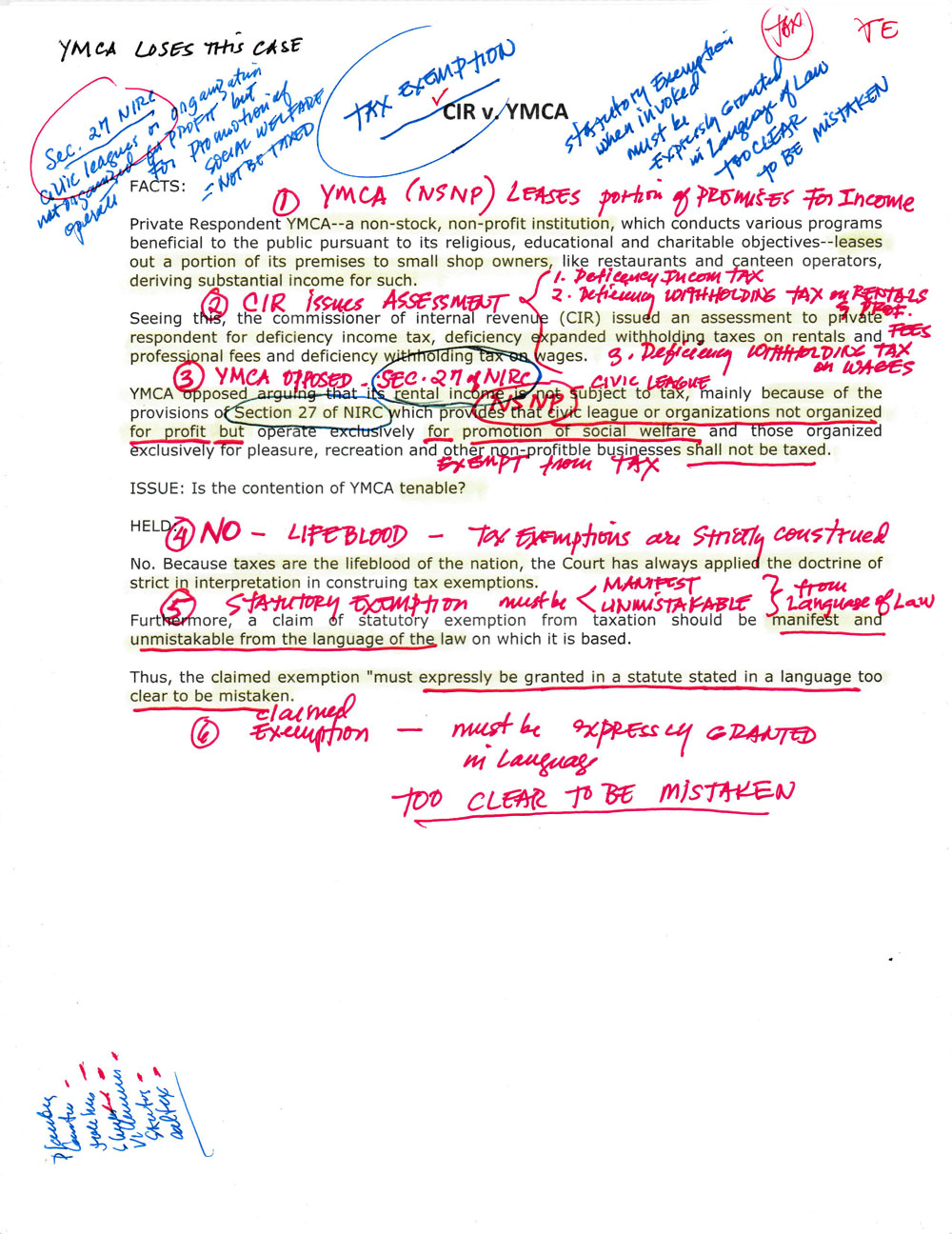
CIR vs. YMCA


Rule:  Tax Exemption if claimed must be expressly granted in a statute stated in a language TOO CLEAR TO BE MISTAKEN. 

Private respondent YMCA, a  non-stock, non-profit institution which conducts various programs beneficial to the public pursuant to its religious, educational, and charitable objectives LEASES OUT a portion of its premises to small shop owners, like restaurants and canteen operators deriving substantial income from such. 

So seeing this, the Commissioner of Internal Revenue (CIR) issued an assessment to private respondent (YMCA) for  Deficiencies on the following: 1. Income tax, 2. Expanded withholding taxes on rentals and professional fees and 3. Withholding tax on wages.   

YMCA opposed arguing that its rental income is not subject to tax mainly because of the provisions of Section 27 of the NIRC (National Internal Revenue Code) which provides that “civic leagues or organizations not organized for profit but operate exclusively for promotion of social welfare and those organized exclusively for pleasure, recreation and other non-profitable businesses SHALL NOT BE TAXED.” 

ISSUE:   Is the contention of YMCA tenable?

HELD:   NO.   Tax Exemptions are:

1. STRICTLY CONSTRUED:
Because taxes are the LIFEBLOOD of the nation. The court has always applied the Doctrine of Strict Interpretation in construing tax exemptions stated in the language of the law.

2. MANIFEST & UNMISTAKABLE: 
Furthermore, a claim of statutory exemption from taxation should be Manifest and Unmistakable from the language of the law on which it is based.

3. BASED ON LANGUAGE TOO CLEAR TO BE MISTAKEN: 
Thus the claimed exemption “must expressly be granted in a statute stated in a language TOO CLEAR TO BE MISTAKEN.”

YMCA loses this case.

(boy, that's as quickest as we can get)


ABAYA vs. EBDANE, JR.


QUESTION:  Must a Taxpayer be a party to a contract in order to challenge it's validity?
ANSWER:  NO. Ratio: TAXPAYER SUIT  

Petitioners Plaridel M. Abaya who claims that he filed the instant petition as a taxpayer, former lawmaker, and a Filipino citizen, and Plaridel C. Garcia (birds of the same feather ;p) likewise claiming that he filed the suit as a taxpayer, former military officer, and a Filipino citizen, mainly seeking to nullify a DPWH resolution which recommended the award to private respondent China Road & Bridge Corporation of the contract for the implementation of the civil works known as Contract Package No. 1. They also seek to annul the contract of agreement subsequently entered into by and between the DPWH and China Road & Bridge Corporation pursuant to said resolution. 

Respondent defends Petitioners don’t have Locus Standi since they are not party to the contract.

ISSUE:

Do petitioners have the LOCUS STANDI (Legal Standing) to file the instant case against the government notwithstanding  that they are not a party to the contract to challenge its validity?

RULING:

YES. As TAXPAYERS  they have Locus Standi to file the present suit. 

Briefly stated, locus standi is a right of appearance in a court of justice on a given question. More particularly, it is a party’s personal and substantial interest in a case such that he has sustained or will sustain direct injury as a result of the governmental act being challenged. 

Locus standi however is merely a matter of procedure and it has been recognized that in some cases, suits are not brought by parties who have been personally injured by operation of law or any other government act but by concerned citizens, taxpayers or voters who actually sue in the public interest.  Consequently , the court in a catena of cases, has invariably adopted a liberal stance on locus standi, including those cases involving taxpayers. 

Ito yung kaya minsan maynaririnig kang nagfafile ng kaso pero wala naman silang kinalaman sa kontrata or agreement or deal and sinasabi lang nila "at baket taxpayer ako ah? baket ba?".  It is what you call a TAXPAYER’S SUIT. The prevailing doctrine in Taxpayer's Suit is to allow taxpayers to question government contracts especially pag merong

1. illegal disbursement of public funds
2. the public money is being deflected to some other purpose or to someone's private bank account, or they see
3. wastage of public funds through the enforcement of an invalid or unconstitutional law entered into by the national government or GOCCs  allegedly in contravention of the law. 

Significantly, a taxpayer need not be a party to the contract to challenge its validity.  

So if you see the same or have personal knowledge of the same, do remember that as taxpayer, you have the legal standing (locus standi) to file a case in court against the irregularity you see in the government. So di mo na kailangan magsumbong pa kay President Digong, and di mo na din kailangan pang magcreate ng sangkatutak na memes sa social media.  You yourself as taxpayer have the right to question those irregularities in court, kaya sige dong, day, ate, koya ifile mo na yung case, sige te ihugot mo te  :)